Life Scripts & Patterns
What They Are and How to Break Them
Most people don’t realise they are living a scripted life. They think they’re making choices, while quietly repeating patterns that were written long before they had language for them.
Life scripts shape who you become, what you tolerate, how you love, how you work, and what you believe is possible for you. They operate beneath motivation and willpower. And until you see them, they run the show.
This page will help you understand what life scripts are, how they form, why they persist even when they hurt, and what it actually takes to break them — not conceptually, but in lived reality.
Life scripts are internalised patterns that tell you who you are allowed to be, how the world works, and what you must do to belong, survive, or be loved.
They are not conscious decisions. They are adaptive responses.
Scripts sound like:
Once formed, scripts quietly dictate behaviour, identity, and emotional range.
“What is a life script in simple terms?”
A life script is an unconscious pattern that tells you who you’re allowed to be and what keeps you safe. It’s formed early through family dynamics, cultural expectations, and what earned you love or approval.
The Over-Functioner
You take responsibility for everything and everyone. You’re the one who holds it together while slowly burning out beneath the competence.
The Pleaser
You manage other people’s emotions at the cost of your own. Your needs get postponed indefinitely because keeping peace feels like survival.
The High Achiever
You succeed externally while feeling hollow inside. No achievement is ever enough because worth still feels conditional.
The Invisible One
You minimise yourself to stay safe. You’ve learned that being small prevents conflict, rejection, or overwhelming attention.
These scripts don’t mean something is wrong with you. They mean something once worked.
If scripts hurt, why don’t we just change them?
Because scripts offer:
Your avoidance isn’t random. It’s diagnostic.
→ See also: Your Avoidance Is a Map
Scripts don’t persist because you’re weak. They persist because they once protected you.
Most approaches try to change scripts at the mind level.
They rely on:
These help you understand the script. They rarely help you interrupt it.
But scripts live in the nervous system, identity, and relational field — not just thoughts. (Read: Healing Identity Wounds)
You can understand exactly why you do something and still find yourself doing it. That’s how scripts work. They operate at a level beneath conscious awareness.
UNSCRIPT™ is not about fixing you. It’s about helping you see:
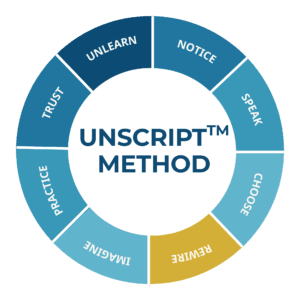
This is not fast. And it’s not performative.
It’s not for people looking for motivation, hacks, or surface change.
Are life scripts the same as habits?
No. Habits are behavioural patterns you can change with repetition — go to the gym, stop scrolling, drink more water. Scripts are identity-level — they determine who you believe you’re allowed to be.
You can change a habit in 30 days. Changing a script requires restructuring identity itself.
Can you break scripts without therapy or coaching?
Awareness helps, but sustained change usually requires relational and embodied work because scripts were formed in relationship and live in the nervous system, not just the mind.
Reading about patterns, journaling, noticing when you’re performing — these create visibility. But scripts were formed in relationship and live in the nervous system, not just the mind.
How long does unscripting take?
There’s no fixed timeline—some patterns shift quickly once seen, while others are load-bearing and require patience, support, and tolerance for disorientation.
Depth determines duration. Some patterns shift quickly once seen. Others are load-bearing — they’re holding up your entire sense of self, and dismantling them requires patience, support, and tolerance for disorientation.
Will breaking a script disrupt my relationships?
Often, yes. When you stop performing your assigned role, some relationships deepen while others reveal they were conditional on you staying small or agreeable.
When you stop performing your assigned role, the people around you will notice. Some relationships deepen when you show up more authentically. Others reveal they were conditional on you staying small, agreeable, or accommodating.
Is this trauma work?
Sometimes. Not all scripts come from trauma, but many do. UNSCRIPT™ addresses both—scripts formed through harm and scripts formed through ordinary conditioning.
The methodology adapts to what you’re working with.
Can I unscript one area of life only?
You can start somewhere — relationships, work, family. But scripts tend to generalise. The pattern showing up in your romantic relationships is likely connected to the pattern in your work dynamics.
Addressing one often illuminates others.
What if I don’t know my script yet?
That’s where the work begins. Most people sense something is off — they feel stuck, exhausted, or misaligned — but can’t name the pattern. Script visibility is the first phase of UNSCRIPT™.
And it often brings immediate relief just to see what’s been running beneath awareness.
You don’t need another insight.
You need interruption, support, and integration.

One focused session to identify your core scripts, understand where they’re costing you, and map your next steps. This isn’t coaching — it’s pattern recognition with someone who sees what you can’t yet see.

6-week small group program for systematic pattern interruption and integration. Weekly live sessions, guided work between sessions, and access to a cohort doing the same depth work.


 Identity Transformation